
AI for Competitive Analysis: Future Outlook
AI is shifting competitive analysis from periodic reports to continuous, real-time intelligence, combining autonomous agents, proprietary data, and oversight.

The way businesses analyze competitors is changing fast. Traditional approaches like quarterly reports and manual research are no longer enough. AI-powered tools now provide real-time insights, helping companies understand markets and competitors in minutes. These tools process data from diverse sources - news, social media, financial reports - offering businesses a sharper edge in decision-making. With AI projected to add $2.6–$4.4 trillion annually to the global economy, the stakes for adoption are high.
In this article, you'll discover:
- How current AI systems streamline competitive analysis, saving time and improving accuracy.
- Key advancements expected by 2027, such as autonomous digital agents and real-time monitoring.
- Actionable steps for integrating AI into your business, maximizing ROI and staying ahead of competitors.
As businesses face increasing global competition, adopting AI is no longer optional. The tools are advancing rapidly, and organizations must act now to ensure they remain competitive. Let’s explore how AI can transform your approach to market intelligence.
The Future of Competitive Intelligence: How AI and Human Expertise Redefine Advantage By Oliver
1. Current AI Capabilities in Competitive Analysis
AI systems today act as strategic allies, analyzing competitive intelligence across various dimensions. These platforms fulfill five key roles: researcher, interpreter, thought partner, simulator, and communicator. As researchers, AI tools can comb through extensive datasets from millions of companies, generating targeted M&A shortlists or flagging competitive threats in just minutes. In the role of interpreter, AI integrates diverse data sources - such as patents and customer reviews - to assess whether market trends are gaining momentum or losing steam. This multi-faceted functionality sets the stage for the advanced data processing capabilities discussed below.
Modern platforms consolidate over 10,000 external data sources, including SEC filings, trade journals, broker research, and more than 175,000 transcripts of expert calls, alongside internal enterprise data, creating centralized intelligence hubs. Leveraging Natural Language Processing (NLP), these systems go even further, detecting tonal shifts in earnings calls and assigning numerical sentiment scores to help track changes in market perception over time.
Prediction accuracy has reached new heights. Hybrid optimization models, blending Transformer models with Reinforcement Learning, have achieved accuracy rates of 92% for market share predictions, 91% for profit growth, and 89% for customer satisfaction. Real-time monitoring tools now deliver instant alerts on competitor website updates, pricing changes, and regulatory filings, shifting competitive intelligence from a reactive to a proactive approach. Additionally, AI simulators can evaluate the effects of macroeconomic trends and competitor strategies, notifying teams when market signals suggest a need for strategic adjustments.
Despite these advancements, strategic decisions still rely heavily on human judgment. McKinsey emphasizes the importance of "strategic courage" - the ability to make bold decisions based on synthesized insights. As Alexander D'Amico, Senior Partner at McKinsey & Company, explains:
Artificial intelligence can't - and, we believe, won't - replace human logic and interpretation in a complex domain, such as strategy.
Organizations with advanced AI expertise are embracing this balance. By 2024, 73% of companies are expected to adopt generative AI tools "fast or very fast". However, they also maintain strict human oversight to address risks like AI hallucinations or strategic blind spots. While AI excels at synthesizing data and modeling scenarios, human analysts remain essential for creative problem-solving, strategic prioritization, and making the final calls that drive competitive success. Together, AI and human expertise create a powerful synergy - AI delivers precision and speed, while humans ensure adaptability and innovation.
2. Future AI Developments in Competitive Analysis
The future of AI in competitive analysis is poised to bring transformative changes, particularly in how businesses approach forecasting and strategy. By 2027, global enterprise investments in generative AI are expected to surpass $150 billion, signaling a shift from reactive analysis to more forward-thinking, proactive decision-making. Four key advancements will drive this evolution: extended forecasting horizons, proprietary data ecosystems, autonomous digital agents, and continuous sensing systems.
Extended forecasting horizons enable strategic foresight. AI is now pushing the boundaries of forecasting, allowing businesses to plan for three years or more into the future. These advanced models act like simulation engines, helping strategists explore a range of potential scenarios shaped by factors such as macroeconomic trends, competitor actions, and stakeholder responses. Instead of relying on straightforward trend projections, these tools help detect subtle signals of potential disruptions before they fully emerge. Alexander D'Amico, Senior Partner at McKinsey, highlights this shift:
Strategists' core focus will increasingly become developing hypotheses, testing and learning from them, and maintaining the AI and data infrastructure that enable the conversion of insights into a competitive advantage.
This capability paves the way for deeper, more adaptive strategic planning.
Proprietary data ecosystems as a competitive edge. While public AI tools make external data widely accessible, relying solely on these sources can lead to generic strategies. The companies that stand out will be those that develop unique datasets, such as real-time customer feedback, ethnographic studies, or sensor-driven insights. Public data is valuable, but integrating proprietary metrics - like inventory levels, workforce performance, or historical trends - creates a distinctive advantage. This tailored approach ensures strategies are not just informed but uniquely positioned.
Autonomous digital agents reshape collaboration. The evolution of AI from basic automation to intelligent agents is revolutionizing workflows. These digital assistants are increasingly capable of handling complex, open-ended tasks, and within the next five years, they may even participate in strategic discussions as digital collaborators. A recent survey found that 80% of business and IT leaders believe generative AI will significantly transform industries in the next three years. However, despite rapid adoption - 73% of organizations are integrating AI quickly - only 30% or fewer of their generative AI experiments had moved into production by late 2024. These agents also introduce new roles, such as "critic agents", which can audit AI models and identify inaccuracies.
Continuous sensing systems redefine intelligence gathering. Future AI systems will rely on always-on dashboards that combine internal and external data sources. These might include social media trends, patent filings, geopolitical developments, and even investment flows, offering real-time insights into market shifts. This approach transforms competitive analysis from an occasional task into an ongoing strategic process. However, as data volumes grow, human expertise will remain critical for filtering out noise and focusing on the most impactful insights.
These advancements position AI as more than just a reactive tool - it becomes an essential component of long-term competitive strategy, empowering businesses to navigate complexity with greater confidence and precision.
Pros and Cons
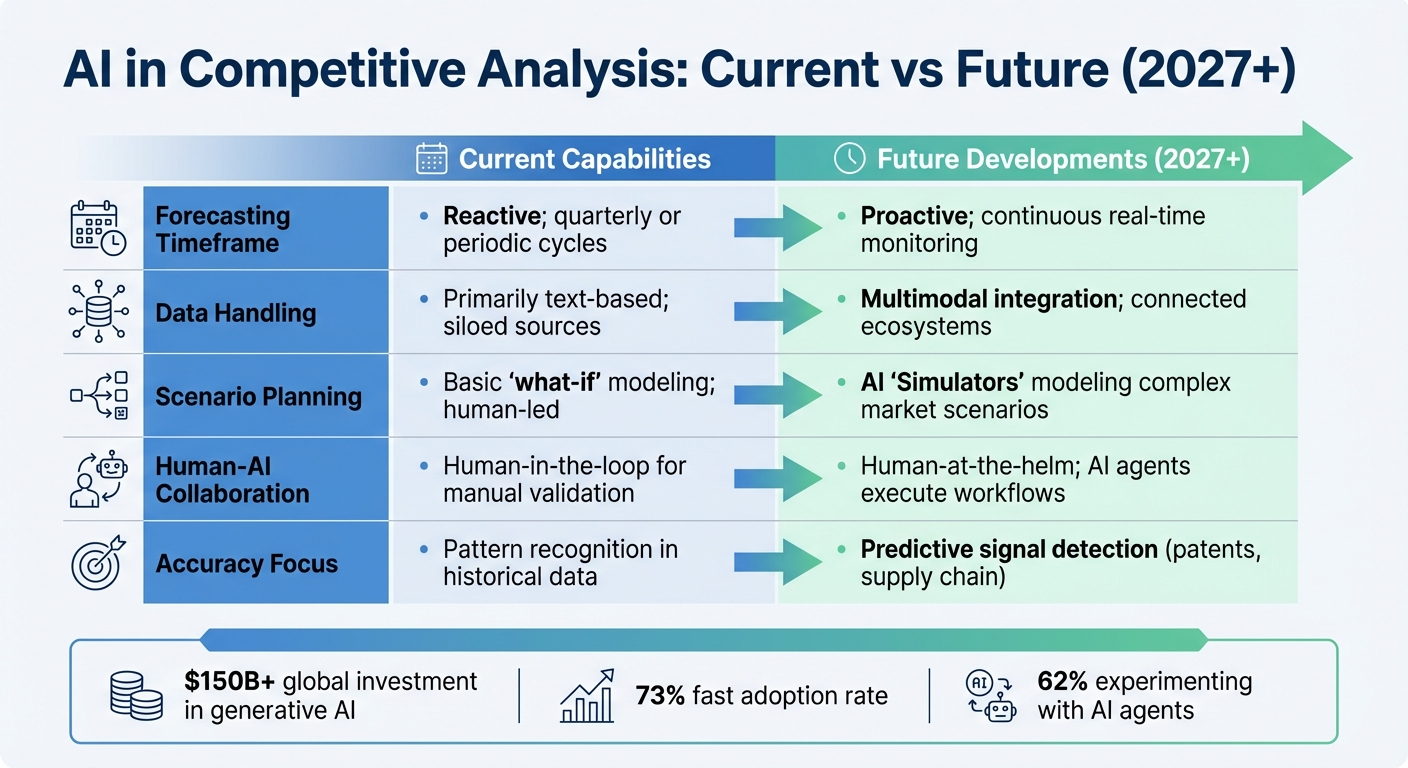
Current vs Future AI Capabilities in Competitive Analysis 2027
The evolution of AI in competitive analysis highlights a trade-off between simplicity and advanced functionality. Today’s AI systems are adept at processing vast amounts of public data rapidly, but they often struggle with accuracy. Looking ahead, future systems are expected to address these shortcomings through autonomous agents and proprietary data ecosystems. However, these advancements may bring new challenges, such as increased costs, greater complexity, and the need for workforce adjustments.
As AI capabilities progress, the focus is shifting from reactive responses to proactive insights. Currently, AI operates reactively and is often aligned with quarterly cycles. In the near future, it will enable continuous, real-time insights, though this will require significant infrastructure investments. For example, 89% of small businesses had adopted AI tools for routine tasks by mid-2025, but these tools primarily rely on text-based data from isolated sources. Future systems promise to integrate multimodal data across interconnected ecosystems. Yet, only 39% of organizations report measurable EBIT improvements at the enterprise level, indicating that more advanced systems won’t automatically lead to better outcomes.
The collaboration between humans and AI is also undergoing a transformation. Alexander D'Amico, Senior Partner at McKinsey, cautions:
companies that use generic inputs will produce generic outputs, which lead to generic strategies that, almost by definition, lead to generic performance or worse.
Currently, humans play a key role in validating AI outputs manually. In the future, humans will take on a more strategic role, guiding AI systems that can execute complex workflows. Notably, 62% of organizations are experimenting with AI agents capable of handling multi-step processes. However, there’s a risk that this could result in superficial productivity gains - generating high volumes of output without adding real strategic value.
The following table provides a concise comparison of current AI capabilities and future developments:
| Feature | Current AI Capabilities | Future AI Developments (2027+) |
|---|---|---|
| Forecasting Timeframe | Reactive; quarterly or periodic cycles | Proactive; continuous real-time monitoring |
| Data Handling | Primarily text-based; siloed sources | Multimodal integration; connected ecosystems |
| Scenario Planning | Basic "what-if" modeling; human-led | AI "Simulators" modeling complex market scenarios |
| Human-AI Collaboration | Human-in-the-loop for manual validation | Human-at-the-helm; AI agents execute workflows |
| Accuracy Focus | Pattern recognition in historical data | Predictive signal detection (patents, supply chain) |
Moving forward, organizations must navigate the balance between democratizing basic insights and developing proprietary data advantages. While global investments in generative AI are projected to exceed $150 billion by 2027, success will hinge not just on adopting the technology but on redesigning workflows to integrate AI into core strategies. Striking the right balance between accessible insights and advanced forecasting will be essential for leveraging AI as a powerful competitive tool.
Conclusion
The role of AI in sales is shifting from tactical tools to autonomous agents, fundamentally altering how competitive analysis is conducted. While today’s AI systems excel at processing historical data and automating routine tasks - with 70% of sellers already leveraging general-purpose AI - the future points toward real-time intelligence operating at machine speed. These systems will soon track pricing changes, hiring trends, and messaging adjustments on a daily basis rather than quarterly. As Andrew Ng, Founder of DeepLearning.AI, aptly puts it:
AI will uncover strategy shifts long before they appear in public markets.
This transformation urges sales teams to rethink their strategies immediately. The "10/20/70 rule" offers a framework: 10% algorithms, 20% technology and data, and 70% people and processes. Sales professionals must evolve into managers of AI workflows, moving beyond simply using software. To ensure accuracy and compliance, organizations should implement governance frameworks and establish AI councils. Companies that integrate automated intelligence pipelines are already outperforming less agile competitors across key markets. This shift highlights how human-AI collaboration will reshape market dynamics.
The competitive edge will increasingly come from proprietary data ecosystems rather than generic, off-the-shelf tools. With 76% of enterprises now sourcing AI solutions from third-party vendors, basic competitive insights are becoming standardized. To avoid falling into the trap Alexander D’Amico warns about:
companies that use generic inputs will produce generic outputs, which lead to generic strategies that, almost by definition, lead to generic performance or worse.
Sales teams must prioritize unique data sources, such as direct customer feedback and ethnographic research, to differentiate their strategies. As AI takes over transactional tasks, human sellers will focus on high-value interactions requiring emotional intelligence and advanced problem-solving. This shift could unlock $0.8 trillion to $1.2 trillion in productivity gains for global sales and marketing. For businesses expanding internationally, platforms like RINDA (https://rinda.ai) illustrate how AI can streamline processes such as discovering overseas buyers, managing multilingual communication, and analyzing performance. This allows sales teams to concentrate on building strategic relationships while AI handles routine competitive analysis.
Ultimately, success will belong to those who redesign their go-to-market workflows around continuous intelligence. The question isn’t whether to embrace these technologies, but how quickly your organization can scale from experimental pilots to fully deployed systems that deliver measurable ROI.
FAQs
How does AI enhance the speed and accuracy of competitive analysis?
AI is reshaping how businesses approach competitive analysis by handling massive volumes of market data with impressive speed and precision. Thanks to natural language processing, it can sift through sources like press releases, earnings reports, patents, and even social media posts in mere seconds - tasks that would traditionally take human analysts days to complete. This rapid processing empowers companies to uncover trends and actionable insights much faster.
Moreover, AI takes the benchmarking process to a whole new level, slashing the time required from 18–25 hours to just 2–3 hours while enhancing both accuracy and thoroughness. It doesn’t stop there - it continuously monitors live data, such as website traffic, keyword rankings, and ad spend, delivering real-time insights that align closely with business objectives. For sales teams, platforms like RINDA highlight these advantages by simplifying buyer identification, crafting tailored outreach strategies, and evaluating performance metrics. This not only saves valuable time but also equips teams to make smarter, data-driven decisions.
What advancements in AI are expected to shape competitive analysis by 2027?
By 2027, artificial intelligence is set to revolutionize competitive analysis through real-time market tracking, predictive modeling, and automated insights. These advanced systems will process competitor data into actionable strategies, project market trends, and predict competitors' actions with impressive precision.
Some of the standout advancements include integration with third-party data platforms, allowing for more comprehensive intelligence gathering, and multilingual AI capabilities, which can translate and interpret global business signals in context. Additionally, scenario-planning models will play a crucial role in helping businesses prepare for potential market changes. Together, these innovations promise to accelerate decision-making and equip businesses with the tools to thrive in an increasingly competitive global market.
How can businesses use AI to enhance their competitive strategies?
To make the most of AI in competitive strategies, businesses need to turn raw data into meaningful insights that drive action. AI tools excel at analyzing a variety of data sources - such as market reports, social media activity, and financial documents - to pinpoint new opportunities or potential risks in near real-time. By leveraging predictive analytics, companies can anticipate competitor moves and shift from reactive responses to proactive strategies.
Some critical steps to achieve this include centralizing data streams, employing AI-driven tools for instant alerts and concise summaries, and weaving these insights into core areas like sales, marketing, and product development. For businesses with extensive field sales teams, AI platforms like RINDA can simplify operations by automating tasks such as identifying international buyers, creating tailored multilingual outreach, and monitoring key performance indicators. Incorporating AI throughout the competitive intelligence process allows businesses to stay ahead of trends, make informed decisions, and ultimately enhance both profitability and growth.